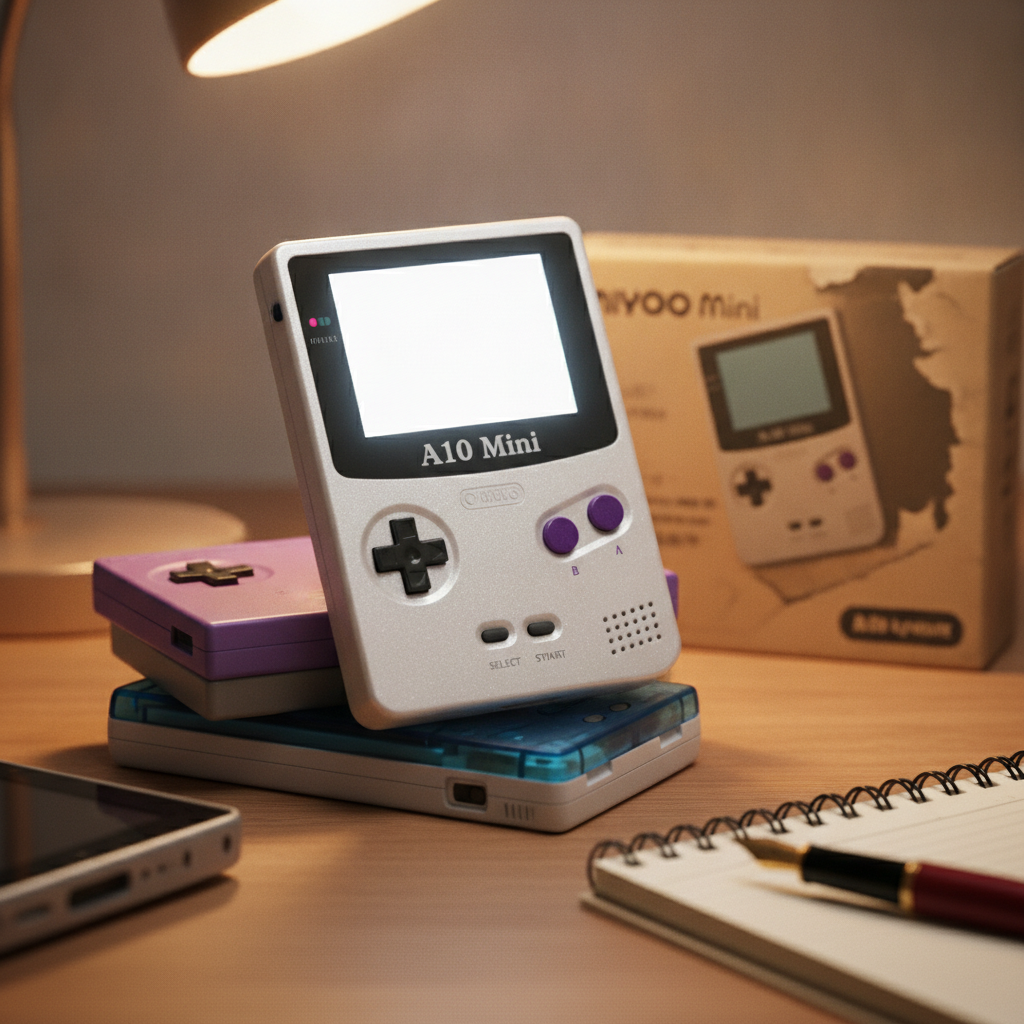
The Shifting Landscape of Pocket Retro Gaming
For a time, the Miyoo Mini reigned supreme in the ultra-portable retro handheld market. Its impossibly small form factor, decent performance for its size, and surprisingly crisp screen made it a darling among enthusiasts. However, as with all good things, the supply of its unique components – specifically, those coveted Blackberry LCD panels – began to dwindle. The Miyoo Mini became a relic, cherished by those who owned one, and a source of frustration for those who missed out.
Into this void steps a new challenger, one that openly acknowledges its inspiration while striving to carve out its own niche: the A10 Mini. Is this device a mere clone, or does it bring enough to the table to genuinely earn a place in the hearts (and pockets) of retro gamers? We’ve spent significant time with the A10 Mini, putting it through its paces to give you the definitive Retpad breakdown.
First Impressions: Design and Build
Picking up the A10 Mini, the immediate sensation is one of familiarity. It closely mimics the compact, vertical form factor that made its predecessor so appealing. The plastic shell feels robust enough for a device in this price bracket, though it lacks the premium heft of more expensive units. Button placement is ergonomic, with the D-pad and face buttons feeling responsive and satisfyingly tactile. The shoulder buttons, often a weak point on budget handhelds, are surprisingly comfortable, offering a decent click without feeling mushy.
One area where the A10 Mini truly shines is its screen. While not identical to the Miyoo Mini’s panel, it offers vibrant colors, good viewing angles, and more than adequate brightness for indoor play. For a device designed primarily for classic games, the resolution is perfectly suited, rendering pixel art with clarity and charm without feeling overly stretched or distorted.
Under the Hood: Performance and Software
Beneath its unassuming exterior, the A10 Mini packs enough processing power to handle a wide array of retro systems. We tested it across various platforms, and it largely impressed. NES, SNES, Game Boy, Game Boy Advance, and Sega Genesis titles run flawlessly, with no noticeable slowdowns or frame drops. This is the bread and butter of most pocket retro handhelds, and the A10 Mini delivers here without breaking a sweat.
Stepping into the 32-bit era, the A10 Mini holds its own remarkably well. PlayStation 1 emulation is strong, with most titles running at full speed. Even more demanding games from the PS1 library performed admirably, making it a fantastic little PS1 machine on the go. arcade emulation (MAME/FBNeo) is also surprisingly capable for many classic titles, though naturally, more complex ROMs will push its limits. Dreamcast and N64 are largely out of reach, which is to be expected for a device of this size and price point, though some lighter N64 titles might be playable with tweaks.
The software experience on the A10 Mini is, by and large, a positive one. It typically ships with a custom firmware that is user-friendly and intuitive, allowing for easy navigation through game libraries and system settings. Community support is already growing, with enthusiasts developing alternative firmwares that further enhance performance and add features, a testament to the device’s potential and the vibrant retro gaming community. Setting up your games is straightforward, and the overall experience feels polished for a budget device.
The Verdict: A Worthy Successor?
So, does the A10 Mini truly fill the void left by the disappearing Miyoo Mini? In many respects, absolutely. It offers a similar compact form factor, excellent screen quality, and robust performance for its target systems. It’s a device that punches above its weight, providing a genuinely enjoyable retro gaming experience at a price point that’s hard to beat.
While it might not have the exact same panel or the same cult status as its spiritual predecessor, the A10 Mini distinguishes itself by being readily available, offering solid performance, and fostering a growing community. For anyone looking for a highly portable, affordable, and capable retro handheld for classic 8-bit and 16-bit games, with a healthy dose of PS1 on top, the A10 Mini is not just a clone; it’s a legitimate contender that earns its keep. It’s a reminder that innovation and accessibility can thrive even in the wake of scarcity, providing new avenues for enjoying the games we love.