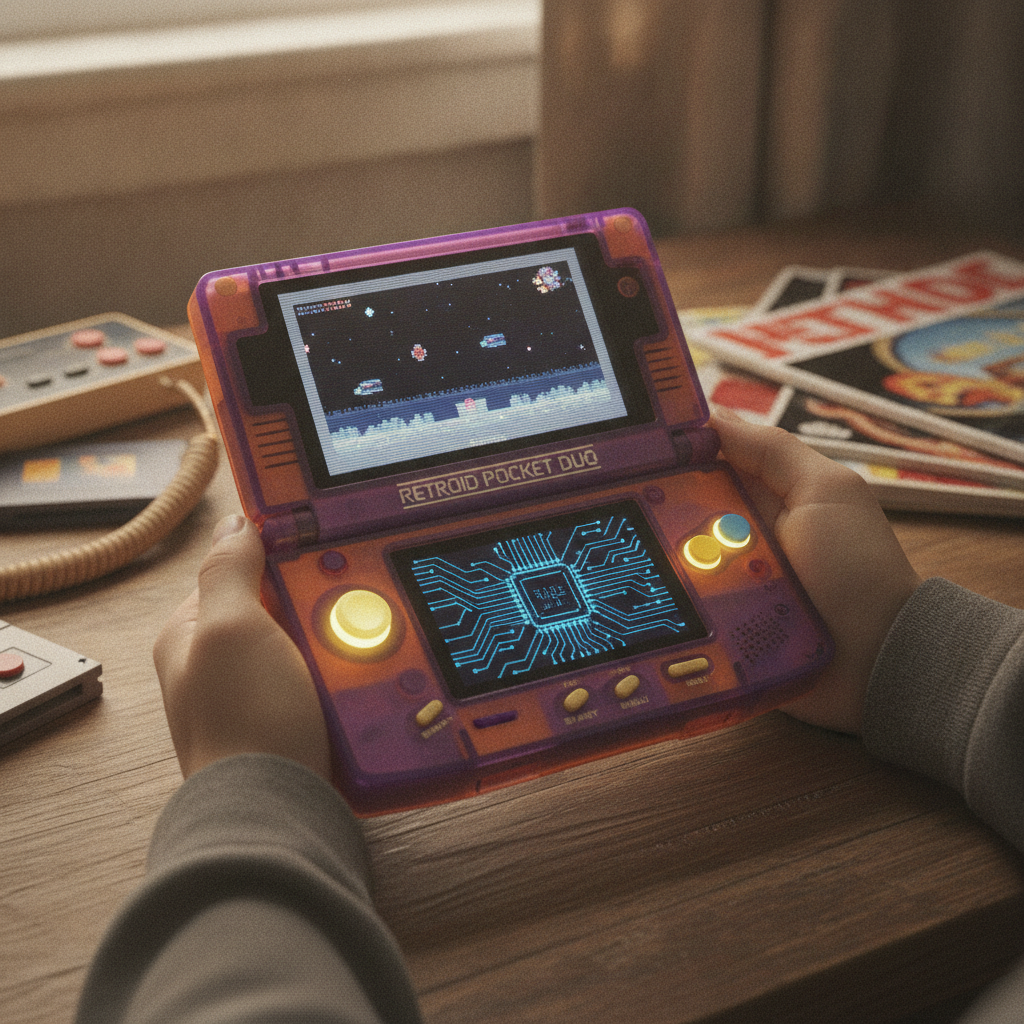
The world of retro handhelds is no stranger to innovation, but every now and then, a device emerges that truly catches the community’s attention. Retroid, a name synonymous with quality and affordability in the emulation space, has just done precisely that with their first official announcement for the Retroid Pocket Duo. This isn’t just another incremental upgrade; it’s a bold departure, introducing a dual-screen clamshell design that promises to shake up how we experience classic games on the go.
For years, many enthusiasts have dreamt of a modern handheld that could genuinely capture the magic of dual-screen gaming without compromise. While devices like Nintendo’s DS and 3DS families cemented the utility and creativity possible with two displays, their unique architecture often made emulation on single-screen devices a bit of a compromise. The Retroid Pocket Duo aims to address this head-on, offering twice the amount of screens as before within a classic clamshell form factor. This design choice immediately brings a wealth of possibilities to the forefront.
Imagine playing Nintendo DS classics with their intended two-screen layout, no more awkward screen switching or tiny superimposed displays. Beyond direct DS emulation, the dual-screen setup could offer entirely new ways to interact with other systems. Developers and community members might even find innovative ways to utilize the second screen for maps, inventories, strategy guides, or even unique control overlays for single-screen systems. This flexibility is a potential game-changer, moving beyond mere emulation to enhance the entire retro gaming experience. The clamshell design itself is a welcome return for many, offering superior screen protection when not in use and a compact, pocketable form factor that’s ideal for travel.
While the initial announcement focuses on the groundbreaking design, the murmurs around a “Processor Reveal” in the title hint at another crucial piece of the puzzle. For a dual-screen device, especially one aspiring to run more demanding systems, the underlying chipset is paramount. Retroid has a history of selecting capable processors that strike an excellent balance between performance, power efficiency, and cost. For the Pocket Duo, the processor will need to comfortably handle not just the rendering of two simultaneous screens but also the potentially more intensive emulation demands of systems that leverage such a setup. Will it be a step up from their current offerings, perhaps a chip capable of pushing into more challenging emulation territories with greater stability? The community is abuzz with speculation, hoping for a robust solution that ensures smooth performance across a wide library of retro titles.
The excitement surrounding the Retroid Pocket Duo is palpable. It represents Retroid’s willingness to innovate and listen to the evolving desires of the retro gaming community. With its unique dual-screen approach and the promise of a capable processor, the Pocket Duo is positioned to be more than just a novelty; it could be a significant milestone in portable retro gaming. As we eagerly await more details, especially regarding the full specifications and release date, one thing is clear: Retroid is once again pushing the boundaries and inviting us to consider what’s truly possible in the palm of our hands. The question isn’t just what the Pocket Duo can do, but what new experiences it will inspire.