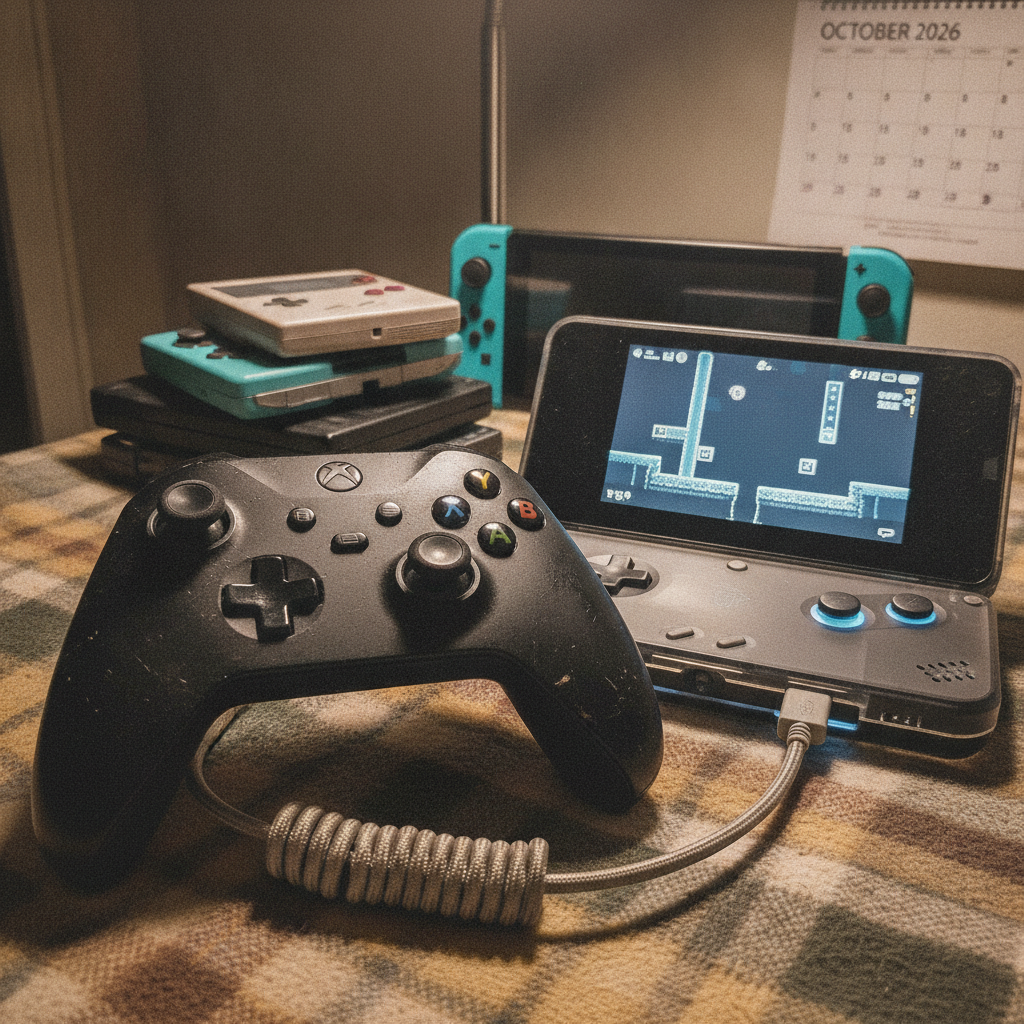
In the fast-paced world of gaming, where new hardware and peripherals seem to emerge every other week, it’s easy for even the most iconic devices to fade into obsolescence. Yet, one piece of equipment has consistently held its ground, becoming synonymous with comfortable, reliable gameplay: the Xbox Wireless Controller. As we navigate 2026, a year brimming with next-generation innovations and fierce competition, the question looms large: can this stalwart of the gaming world still justify its place as a go-to choice for players? At Retpad, we’ve put the latest iteration through its paces to see if “Ole Reliable” still has the chops.
A Legacy Forged in Play
The journey of the Xbox controller into gaming legend is well-documented. From its early, somewhat bulky iterations to the refined designs we know today, Microsoft’s controller has consistently set a benchmark for ergonomics and cross-platform compatibility. It became, for many, the default PC controller, instantly recognized and supported by countless titles. This widespread adoption wasn’t accidental; it was built on a foundation of robust build quality, intuitive button placement, and a comfort level that allowed for hours of uninterrupted play. Its consistent design language across generations has also fostered a sense of familiarity, making it an easy transition for gamers upgrading their consoles or moving between platforms. This enduring legacy is a powerful asset, but does history alone make it relevant today?
Design & Ergonomics: Still the Gold Standard?
Pick up an Xbox Wireless Controller, and you immediately understand why its design has been so influential. The contoured grips fit naturally in the hand, the asymmetric stick layout feels remarkably intuitive for a vast array of genres, and the trigger and bumper buttons are perfectly positioned for responsive action. In 2026, while many competitors have experimented with radical new shapes and features, the Xbox controller largely sticks to its winning formula. This isn’t a bad thing; its comfort remains unparalleled for many, especially during extended gaming sessions where fatigue can quickly set in with less thoughtfully designed alternatives. The subtle texturing on the triggers and rear grips provides just enough friction, ensuring a secure hold even during intense moments. While some might crave more customization or experimental layouts, the core design philosophy here is about universal appeal and proven comfort.
Performance & Responsiveness: Keeping Up with the Times
When it comes to raw performance, the Xbox Wireless Controller still delivers. Input lag is negligible, offering a fluid and immediate connection between your commands and the on-screen action. The thumbsticks, while perhaps not offering the same level of granular tension adjustment as some high-end pro controllers, provide excellent precision and a satisfying resistance. The face buttons have a distinct, tactile click that instills confidence, and the D-pad, which received a significant upgrade in recent generations, is now impressively accurate for fighting games and platformers alike. The haptic feedback, while not as advanced or nuanced as some competing technologies, provides satisfying rumble that immerses you in the game without being distracting. Wireless connectivity via Xbox Wireless or Bluetooth is generally rock-solid, ensuring a stable connection whether you’re tethered to an Xbox, a PC, or even a mobile device.
Battery Life & Power Solutions
One area where the Xbox controller often sparks debate is its power solution. Sticking with AA batteries as a default might seem archaic in a world of integrated rechargeable packs, but it offers a unique flexibility. For those who prefer immediate swaps, a fresh pair of AAs means instant power. For others, official or third-party rechargeable battery packs seamlessly integrate, offering convenience without sacrificing the controller’s fundamental design. In 2026, the arguments for both sides still hold weight, but the choice remains yours. While some might long for a built-in battery and USB-C charging out of the box, the flexibility of the current system ensures that you’re never truly out of juice, provided you have spares or a charging solution at hand.
Ecosystem & Compatibility: Its Undeniable Strength
Perhaps the greatest enduring strength of the Xbox Wireless Controller is its unparalleled ecosystem and compatibility. It’s not just for Xbox consoles; it’s practically the default standard for PC gaming, offering plug-and-play functionality with almost every title imaginable. Beyond traditional gaming rigs, its robust Bluetooth connectivity allows it to pair effortlessly with Android and iOS devices, expanding its utility to cloud gaming services and mobile titles. This versatility means one controller can truly be your all-in-one solution across multiple platforms, reducing clutter and offering a consistent experience no matter where you choose to play. In a world increasingly dominated by multi-platform gamers, this universal appeal is a significant advantage.
The Competitor Landscape: Where Does It Stand?
The controller market in 2026 is bustling with innovation. From PlayStation’s DualSense, with its groundbreaking haptic feedback and adaptive triggers, to a myriad of third-party “pro” controllers boasting modular components, back paddles, and hyper-customizable profiles, the Xbox Wireless Controller isn’t alone at the top anymore. These competitors often offer features that the standard Xbox controller lacks, catering to a niche of highly competitive or customization-focused players. However, these advanced features often come at a premium price. The Xbox controller, in contrast, positions itself as the accessible, supremely reliable choice that covers all the essentials with aplomb, proving that sometimes, doing the fundamentals exceptionally well is more valuable than a laundry list of cutting-edge, yet potentially superfluous, additions.
The Verdict: Ole Reliable or Outdated?
So, as 2026 rolls on, where does the Xbox Wireless Controller stand? Is it an outdated relic clinging to past glories, or does it remain a relevant, essential piece of gaming hardware? Our deep dive at Retpad confirms its status as an enduring champion. While it may not boast the most experimental features or the most cutting-edge haptics, its core strengths—unrivaled ergonomics, robust build quality, dependable performance, and vast cross-platform compatibility—continue to make it an incredibly compelling option. It’s not just “Ole Reliable”; it’s a testament to timeless design and functional excellence. For the vast majority of gamers seeking a comfortable, responsive, and universally supported controller without breaking the bank, the Xbox Wireless Controller remains, unequivocally, a go-to in 2026. It proves that sometimes, perfection is found not in constant reinvention, but in consistently delivering on core promises.